 May 23 2026
 May 16 2026
 May 09 2026
 May 02 2026
 Apr 25 2026
 Apr 18 2026
 Apr 11 2026
 Apr 04 2026
 Mar 28 2026
 Mar 21 2026
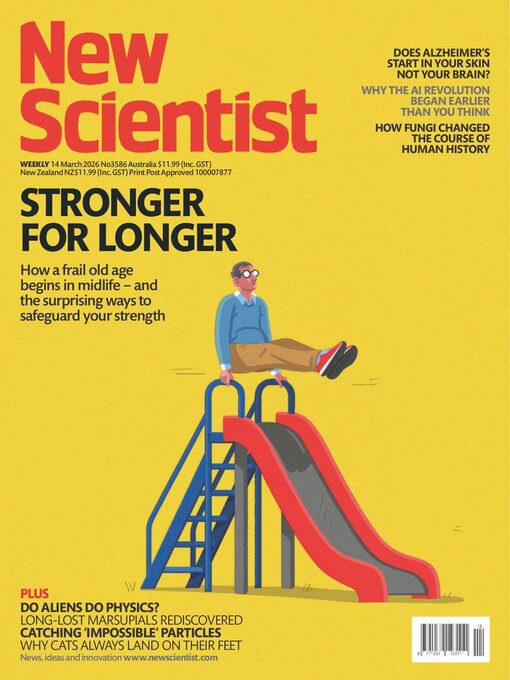
 Mar 14 2026
 Mar 07 2026
 Feb 28 2026
 Feb 21 2026
 Feb 14 2026
 Feb 07 2026
 Jan 31 2026
 Jan 24 2026
 Jan 17 2026
 Jan 10 2026
 Jan 03 2026
 Dec 27 2025
 13/20 December 2025
 Dec 06 2025
New Scientist covers the latest developments in science and technology that will impact your world. New Scientist employs and commissions the best writers in their fields from all over the world. Our editorial team provide cutting-edge news, award-winning features and reports, written in concise and clear language that puts discoveries and advances in the context of everyday life today and in the future.
A midlife tune-up • Healthy habits in your 50s could pay dividends in old age
New Scientist Australian Edition
Alzheimer’s may start outside the brain • Inflammation in organs like the skin, lungs and gut during midlife may trigger Alzheimer’s disease in later years. If so, we will need to totally rethink how we treat the condition, reports Alice Klein
The first apes to walk upright could have evolved in Europe
Earth is heating up faster than before
Signs key ocean current is weakening • Significant changes to the flow of the Gulf Stream may already be happening, and more sudden shifts could have severe climate impacts, finds Alec Luhn
Global sea levels are much higher than we thought
Psychedelic provides OCD relief • We may have found a way to ease the symptoms of obsessive-compulsive disorder among people who don’t respond to conventional treatments, finds Chris Simms
Chemistry clues could be the key to finding extraterrestrial life
The secret to how cats always land on their feet
Inside the team that shook the world
The beginning of the AI revolution • It’s been 10 years since Go champion Lee Sedol lost to DeepMind’s AlphaGo. Alex Wilkins explores how this event shaped the future of AI
‘Singing’ dogs may show roots of musicality
Is this why some families have all boys? • Selfish genes could prevent parents from being able to have daughters
We’ve changed an asteroid’s orbit around the sun
Möbius strip-like molecule has a bizarre shape
Top predators survived mass extinction
‘Extinct’ marsupials found alive • Two marsupial species thought to have died out in Australia 6000 years ago are alive and well on New Guinea – though they are under threat from logging, finds James Woodford
Your microbiome may shape the severity of allergic reactions
Drones could soon be used to carry people
Phantom codes could help quantum computers avoid errors
Ants capture carbon dioxide and turn it into armour
Why I have changed my mind about AI and you should too • After an experiment in vibe coding, I have realised that both the boosters and the sceptics are wrong about AI, says Jacob Aron
Do magnesium supplements really improve sleep and energy? • Magnesium has been hailed for its benefits to the brain and body. But Alice Klein finds evidence is lacking for many of these claims
Gold in the hills
“Astronomy enlivens the spirit” • Space scientist Maggie Aderin talks telescopes, neurodiversity and being underestimated with Rowan Hooper, as her memoir Starchild comes out
New Scientist recommends
Pinning down protein • A new deep dive into our current passion for protein is well-timed – but does it actually have any answers? Alexandra Thompson explores
Two more interesting books on diet
Your letters
How to stay strong • Frailty can set in far earlier than you’d expect, with people in their 30s and 40s showing signs. But there are surprising ways to overcome this, finds David Cox
The first fungi foragers • Archaeologists are starting to uncover the pivotal role mushrooms played in ancient human survival, discovers Benjamin Taub
“Cosmic neutrinos come from some of the most violent processes in the universe” • Last year, astronomers spotted a seemingly impossible particle. Carlos...